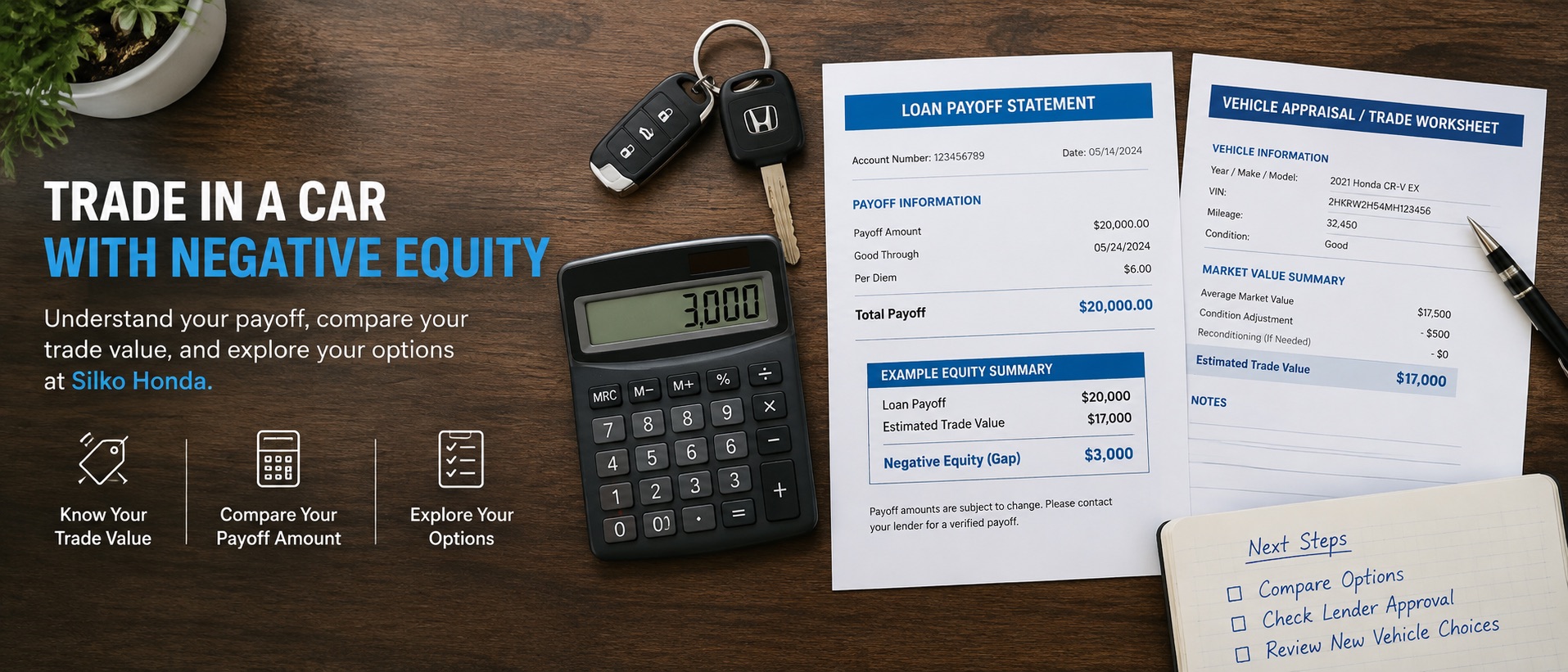
Trade In a Car With Negative Equity
If you owe more on your auto loan than your vehicle is currently worth, you have negative equity. You may still be able to trade in the vehicle, but the difference between its trade-in value and your loan payoff has to be addressed as part of the transaction.
At Silko Honda in Raynham, MA, we can help you compare your vehicle's estimated trade value with its current payoff amount so you can understand the numbers before deciding what to do next. Depending on your situation, possible paths may include paying some or all of the difference, continuing to pay down the current loan, selling the vehicle separately, or including an eligible portion of the balance in new financing if a lender approves the transaction.
Quick Answer
Can You Trade In a Car With Negative Equity?
Yes, trading in a car with negative equity may be possible. The difference between your loan payoff and the vehicle's trade-in value does not disappear. It has to be accounted for through the transaction, and any amount included in new financing is subject to lender approval and may increase how much you borrow.
Understanding the Basics
What Is Negative Equity on a Car?
Negative equity means you owe more on an auto loan than the vehicle is currently worth. You may also hear this described as being "upside down" or "underwater" on the loan.
Current Loan Payoff
$20,000
Trade-In Value
$17,000
Negative Equity
$3,000
In this example, the vehicle is worth $17,000 as a trade but requires $20,000 to satisfy the existing loan. That creates a $3,000 equity gap.
Loan Payoff − Trade-In Value = Negative Equity
Quick Calculator
Calculate Your Estimated Trade Equity
Enter your current payoff and estimated trade value to see whether the numbers indicate positive or negative equity. You can also enter an optional cash contribution to see how much of an equity gap may remain.
This calculator is for planning purposes only. Your actual payoff amount, final appraisal, financing availability, and transaction details may differ.
Why Do Cars End Up With Negative Equity?
Negative equity can develop when a vehicle's value decreases faster than the outstanding loan balance. Several factors can contribute.
Swipe or scroll to see each factor.
Vehicle Depreciation
Vehicles generally lose value over time, and depreciation can occur faster than the loan principal declines, particularly earlier in the ownership period.
Longer Loan Terms
A longer repayment period can reduce the required monthly payment while causing the loan balance to decline more gradually.
Limited Initial Equity
A smaller down payment or financing a larger portion of a vehicle transaction can leave less initial equity in the vehicle.
Previous Negative Equity
If a balance from a previous vehicle was included in the current financing, the loan can begin with more debt relative to the vehicle's value.
30.9%
of new-vehicle trade-ins carried negative equity in Q1 2026
Negative Equity Is Not Unusual
Edmunds reported that 30.9% of trade-ins toward new-vehicle purchases carried negative equity during the first quarter of 2026. Among those underwater trade-ins, the average amount owed above vehicle value was $7,183.
Those figures do not determine what any individual vehicle or loan is worth, but they illustrate why knowing your current payoff and trade value matters before deciding whether to replace a vehicle.
Start With the Numbers
Find Your Estimated Trade Value
Before you can determine whether you have positive or negative equity, you need two numbers: your current payoff amount and an estimate of what your vehicle may be worth as a trade.
Step by Step
How to Trade In a Car With Negative Equity
The exact process can vary with the vehicle, existing lender, next vehicle, and financing arrangement. These six steps can help you understand the numbers before making a decision.
Swipe or scroll through the six steps.
Request Your Current Payoff Amount
Your payoff may differ from the balance shown on your most recent statement because of accrued interest or other amounts permitted by the loan agreement.
Ask your lender for a current payoff quote, note how long it remains valid, and check whether your agreement includes a prepayment penalty or other early-payoff provision.
Estimate Your Trade-In Value
Condition, mileage, equipment, history, market demand, and recent comparable transactions can affect value. An online estimate is a useful starting point, while the final trade value generally requires an appraisal of the actual vehicle.
Calculate the Equity Gap
Subtract the vehicle's trade-in value from the payoff amount. If the payoff is higher, the difference represents your negative equity.
Compare Ways to Handle the Difference
You might pay some or all of the gap directly, continue paying down the vehicle, compare selling separately, or explore whether a lender will permit an eligible amount to be included in new financing.
Review the Complete Financing Picture
Look at the vehicle price, trade allowance, payoff, down payment, amount financed, APR, loan term, finance charge, and total of payments when applicable rather than judging the transaction by monthly payment alone.
Confirm the Old Loan Is Satisfied
After completing a trade involving an existing loan, confirm with your previous lender that the payoff was received and the account has been satisfied according to the transaction.
Ways to Address Negative Equity
There is no single approach that is best for every shopper. Compare the alternatives based on the equity gap, your current vehicle needs, available cash, and lender requirements.
Financing Impact
How Negative Equity Can Affect Your Next Auto Loan

If a lender approves some or all of the negative equity as part of the next auto loan, the unpaid difference from the previous vehicle becomes part of the amount being financed. Paying off the previous lender does not make that debt disappear.
Example: Rolling $4,000 of Negative Equity Into the Next Loan
Without Rolled Equity
$30,000
Replacement vehicle: $30,000
Previous negative equity: $0
With $4,000 Negative Equity
$34,000
Replacement vehicle: $30,000
Previous negative equity: $4,000
This simplified example excludes taxes, registration, optional products, cash down, credits, and other applicable transaction items. Its purpose is to show that $4,000 of negative equity represents $4,000 of additional debt if the entire amount is included in the next financing.
Negative Equity and Loan-to-Value Ratio
Loan-to-value ratio, or LTV, compares the amount being financed with the value of the vehicle securing the loan. Lenders may consider LTV along with credit history, income, existing debts, down payment, vehicle characteristics, and other underwriting factors.
Including negative equity in another loan can increase the amount borrowed without increasing the replacement vehicle's value by the same amount. That can produce a higher LTV and may affect financing availability or terms. The Consumer Financial Protection Bureau identifies LTV as one factor that can influence auto-loan decisions and terms.
Lender Dependent
How Much Negative Equity Can You Roll Into a New Car Loan?
There is no universal amount of negative equity that can be rolled into another auto loan. The amount, if any, depends on the lender, vehicle being financed, loan-to-value ratio, down payment, credit profile, income, existing obligations, and other underwriting requirements. Approval should never be assumed.
Important
Look Beyond the Monthly Payment
A longer loan term can reduce the required monthly payment while increasing the amount of time you repay the debt and potentially increasing total interest. Review the amount financed, APR, term, finance charge, and total of payments rather than using the monthly payment alone to evaluate the financing.
How to Find Negative Equity in the Deal Numbers
Negative equity can be harder to recognize when every part of the transaction is discussed as one monthly payment. Looking at the major numbers separately makes it easier to understand where the previous vehicle's balance fits.
If your trade is worth $17,000 and your current payoff is $21,000, there is a $4,000 difference that has to be accounted for somewhere in the transaction. If an approved lender permits that amount to be included in the next loan, it becomes additional financing rather than disappearing.
What Does It Mean When a Dealer Pays Off Your Trade?
Paying the previous lender and eliminating negative equity are not necessarily the same thing.
When a financed vehicle is traded, the existing loan payoff generally has to be addressed so the lien can be handled according to applicable lender and title requirements. If the trade value is less than the payoff, the remaining difference still has to be accounted for.
The difference may be addressed with cash, another applicable part of the transaction, or approved new financing. Consumer guidance recommends reviewing the contract carefully and confirming afterward that the previous loan was paid off.
Get Prepared
Before You Trade: What to Know and Bring
Having the important numbers and documents ready can make the trade appraisal and payoff review much easier.
Numbers to Know
- Your current lender payoff amount
- How long the payoff quote remains valid
- Your vehicle's estimated and appraised trade value
- The resulting positive or negative equity amount
- Any cash you plan to contribute
- The total amount you would finance
- The proposed APR, term, finance charge, and total of payments
Items to Bring
- Valid driver's license
- Current vehicle registration
- Vehicle title, if available and applicable
- Current lender and payoff information if financed
- All available keys and remote fobs
- Accessories or equipment associated with the vehicle
- The vehicle itself for a final appraisal
At the Dealership
What Happens When You Bring Your Trade to Silko Honda?
Once you have a starting estimate and current payoff information, we can help turn those numbers into a clearer picture using the actual vehicle and transaction details.
We Appraise Your Vehicle
We review the actual vehicle and consider factors such as condition, mileage, equipment, history, current market demand, and inspection results when establishing its trade value.
We Compare the Appraisal With Your Payoff
If your vehicle is financed, we can compare the applicable payoff information with the appraisal to identify whether you have positive equity or an amount still owed above the vehicle's value.
We Help You Review the Next-Step Numbers
If negative equity is present, we can show you how the trade, payoff, available cash contribution, vehicle choice, and lender-dependent financing may fit together so you can review the complete picture before making a decision.

Silko Honda | Raynham, MA
See the Numbers Before You Decide
We can help you compare your current appraisal, payoff amount, equity difference, and potential next-vehicle numbers so you can see how the pieces fit together before deciding whether to move forward.
Drivers from Raynham, Taunton, Bridgewater, Brockton, and communities across the South Coast can start with an estimated trade value online or contact our team to discuss the next steps.
Common Questions
Trade In a Car With Negative Equity FAQs
Keep Exploring
Vehicle values, payoff amounts, financing availability, rates, terms, down-payment requirements, and lender conditions vary by vehicle and applicant. An online trade-in estimate is a starting point and is not a final appraisal or guaranteed offer. Financing is subject to lender approval. Negative equity may increase the amount financed and the cost of borrowing. Calculator results are estimates for planning purposes only. This page provides general educational information and is not financial, legal, or tax advice.